Have you ever picked up a skincare product, turned the package around, and found a long list of ingredients that seem impossible to understand? From unfamiliar scientific names to tiny symbols and bold claims on the packaging, cosmetic labels can feel confusing, especially when you are shopping for a new moisturizer, cleanser, sunscreen, serum, or makeup product.
Many people choose cosmetics based on the brand, packaging, price, or promises printed on the front. However, understanding the ingredient list can help you make more informed choices, identify ingredients that have caused problems for your skin before, and compare products more carefully.
You do not need a chemistry degree to understand a cosmetic label. By learning how ingredient lists are organized, recognizing common ingredients, understanding product claims, and checking expiry information, you can become a more confident beauty shopper.
In this guide, we will explain how to read cosmetic ingredient labels, what common ingredients do, how to check products for potential irritants, and what to consider before purchasing a new beauty product.
1. Start With the Ingredient List
The ingredient list is one of the most useful parts of a cosmetic package. It tells you which ingredients the manufacturer declares are present in the product, although it does not reveal every detail about their exact concentration or how the finished formula will perform.
Depending on the country and the product category, labeling requirements may differ. In many markets, cosmetic ingredients are listed in descending order by weight when they are added to the formula. This means ingredients used in larger amounts generally appear near the beginning.
For example, a simple moisturizer might list ingredients such as:
- Water (Aqua)
- Glycerin
- Caprylic/Capric Triglyceride
- Cetearyl Alcohol
- Dimethicone
- Preservatives and other ingredients
In this hypothetical example, water is listed first, followed by glycerin and other ingredients. The actual order and ingredients vary from product to product.
Water often appears near the beginning of lotions, creams, and cleansers because it acts as a solvent and helps create the product’s texture. Oils, emollients, humectants, emulsifiers, and other ingredients may follow.
However, the order alone does not tell you whether a product is effective, high-quality, or suitable for your skin. A useful ingredient appearing near the end of a list is not automatically ineffective, because some ingredients are used at low concentrations.
What about ingredients at the end?
In some labeling systems, ingredients present at concentrations of 1% or less may be listed in a different order after the ingredients present at higher concentrations. Color additives can also follow specific ordering rules.
This means you cannot reliably calculate exact percentages simply by looking at the label. Unless the manufacturer provides concentration information, the ingredient list generally gives you an overview rather than a complete formula breakdown.
2. Understand Why Cosmetic Ingredients Have Unfamiliar Names
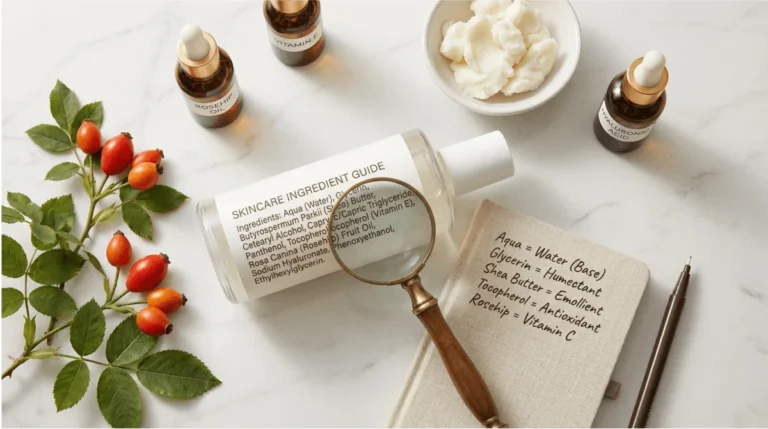
Cosmetic ingredient lists often use standardized names, including names based on the International Nomenclature of Cosmetic Ingredients (INCI) system. These names help manufacturers, regulators, professionals, and consumers identify ingredients across different products and markets.
Although these names may look complicated, they are not automatically signs of harmful chemicals.
Here are a few common examples:
| Name on the label | What it generally refers to |
|---|---|
| Aqua | Water |
| Tocopherol | A form of vitamin E |
| Ascorbic Acid | Vitamin C |
| Glycerin | A moisture-attracting ingredient |
| Sodium Hyaluronate | A form of hyaluronic acid |
| Dimethicone | A silicone used to improve texture and reduce moisture loss |
| Parfum or Fragrance | A fragrance ingredient or mixture |
| Panthenol | An ingredient commonly used for conditioning and moisturization |
| Niacinamide | A form of vitamin B3 used in skincare |
| Zinc Oxide | A mineral used in certain sunscreens and cosmetic pigments |
The exact function of an ingredient depends on the formula and how it is used.
For example, dimethicone may help a moisturizer feel smooth, while glycerin helps attract water into the outer layers of the skin. Both can appear in products designed for different skin types.
It is also important to avoid judging an ingredient by its name alone. A familiar ingredient is not automatically suitable for everyone, and an unfamiliar ingredient is not automatically dangerous. Safety and suitability depend on factors such as concentration, formulation, exposure, and individual sensitivity.
3. Learn the Difference Between Humectants, Emollients, and Occlusives
Understanding these three ingredient groups can make it easier to choose moisturizers and other skincare products.
They serve different purposes, and many well-formulated moisturizers combine more than one group.
Humectants: Ingredients that attract moisture
Humectants help attract and retain water in the outer layers of the skin. They are commonly included in moisturizers, serums, and hydrating lotions.
Examples include:
- Glycerin
- Hyaluronic acid
- Sodium Hyaluronate
- Urea
- Panthenol
Humectants can help skin feel more hydrated, although the result depends on the full formula and the condition of your skin.
Emollients: Ingredients that soften the skin
Emollients help smooth the skin’s surface and improve its softness. They can be particularly useful when skin feels rough or dry.
Examples include:
- Squalane
- Caprylic/Capric Triglyceride
- Certain plant oils
- Fatty alcohols such as cetyl alcohol and cetearyl alcohol
Despite the word alcohol in their names, fatty alcohols are different from drying alcohols such as ethanol. Fatty alcohols are often used to soften skin and improve the texture of creams.
Occlusives: Ingredients that reduce moisture loss
Occlusives form a protective layer that slows water loss from the skin’s surface.
Examples include:
- Petrolatum
- Mineral Oil
- Dimethicone
- Certain waxes and heavier emollients
These ingredients may be helpful for dry skin, particularly when the skin barrier needs extra support.
Many moisturizers combine humectants, emollients, and occlusives to provide hydration, softness, and protection against moisture loss.
If your skin is oily, you may prefer a lighter-feeling formula. If your skin is dry, a richer cream may feel more comfortable. The ingredient list can provide clues, but the finished product’s texture and performance matter too.
4. Recognize Ingredients Commonly Used for Specific Skincare Goals
Once you understand the basic ingredient groups, you can start looking for ingredients associated with your particular skincare goals.
However, remember that no single ingredient guarantees a specific result. The formula, concentration, frequency of use, and your skin’s individual needs all matter.
For hydration
Look for ingredients such as glycerin, hyaluronic acid, sodium hyaluronate, and panthenol. These are commonly included in products designed to improve skin hydration.
For supporting the skin barrier
Ceramides, glycerin, petrolatum, and certain emollients may help support moisture retention and reduce dryness when used in suitable formulations.
For uneven skin tone
Niacinamide, vitamin C derivatives, and other ingredients may be included in products designed to improve the appearance of uneven tone. Results vary, and persistent pigmentation may require professional guidance.
For acne-prone skin
Salicylic acid is commonly used in products designed for acne-prone skin because it helps exfoliate inside pores. Some products also contain benzoyl peroxide, which is an acne treatment rather than simply a cosmetic ingredient.
These ingredients may cause dryness or irritation, especially if used too frequently or combined with other active products. Follow the label instructions and introduce new treatments gradually.
For exfoliation
Alpha hydroxy acids, such as glycolic acid and lactic acid, are used in some products to exfoliate the skin’s surface. Their effects depend on concentration, pH, formulation, and usage.
Using too many exfoliating products at once may cause irritation. If you are new to exfoliating acids, start cautiously and use sunscreen during the day.
For sun protection
Zinc oxide and titanium dioxide are mineral UV filters used in some sunscreens. Other sunscreens use different approved UV filters, depending on the market and formulation.
Do not judge a sunscreen’s effectiveness by one ingredient alone. Look for the labeled SPF, broad-spectrum protection where available, and clear usage instructions.
5. Understand Preservatives and Why They Matter
Some consumers prefer products labeled preservative-free because they believe preservatives are automatically harmful. However, preservatives play an important role in many cosmetics, particularly products containing water.
Water-based creams, lotions, cleansers, and other formulations can support microbial growth if they are not adequately protected. An appropriate preservative system helps control bacteria, yeast, and mold during the product’s intended use.
Common cosmetic preservatives include certain parabens, phenoxyethanol, sodium benzoate, and potassium sorbate. Which preservatives are permitted, and the conditions under which they may be used, depend on local regulations.
The presence of a preservative does not automatically make a product unsafe. Equally, the absence of a conventional preservative does not automatically make a product safer.
Some products use alternative preservation systems, specialized packaging, or formulas with limited microbial growth potential. Their suitability depends on how the complete product is designed and tested.
If you have a known sensitivity to a specific preservative, checking the ingredient list can help you avoid that ingredient. However, do not assume that every preservative will cause a reaction simply because one product previously irritated your skin.
6. Know When Fragrance May Be a Concern
Fragrance is commonly added to skincare and makeup products to provide a pleasant scent or mask the natural smell of other ingredients.
On labels, fragrance may appear as fragrance, parfum, or another ingredient name, depending on the product and local labeling requirements.
For many people, fragranced cosmetics are comfortable to use. However, fragrance ingredients can cause irritation or allergic contact dermatitis in some individuals.
If you have sensitive skin or a history of fragrance-related reactions, consider products labeled fragrance-free.
It is also useful to understand the difference between fragrance-free and unscented:
- Fragrance-free generally means fragrance has not been added for scent, although you should still check the full ingredient list and applicable labeling rules.
- Unscented means the product is marketed as having little or no noticeable scent. Some unscented products may contain ingredients used to mask other odors.
Neither label guarantees that a product will suit everyone.
If a particular ingredient has caused a reaction in the past, keep a record of its name and check future products carefully. If you repeatedly develop a rash or irritation, a dermatologist can help investigate the cause.
7. Do Not Assume That Natural Ingredients Are Always Better
Words such as natural, plant-based, botanical, and organic often appear on cosmetic packaging. They may describe certain ingredients or manufacturing choices, but they do not automatically establish that a product is safer or more effective.
Plant-derived ingredients can be useful in cosmetics, but they can also cause irritation or allergic reactions in some people. Essential oils, botanical extracts, and naturally occurring fragrance compounds are examples of ingredients that may not suit every skin type.
Similarly, synthetic ingredients are not automatically harmful. Many are used because they offer particular benefits for texture, stability, preservation, or performance.
When comparing products, consider the actual ingredient list, the product’s intended use, your known sensitivities, and how the formula feels on your skin.
Do not choose a product based solely on whether the packaging describes it as natural or chemical-free. All material ingredients are made of chemicals, including water and plant extracts. The more useful question is whether the finished product is appropriately formulated and suitable for your needs.
8. Look Beyond Claims on the Front of the Package
Cosmetic packaging is designed to attract attention, and many products feature claims such as:
- Dermatologist-tested
- Hypoallergenic
- Clean beauty
- Non-toxic
- Natural
- For sensitive skin
- Non-comedogenic
These claims can provide clues about how a product is marketed, but their meaning and regulatory requirements vary by country and product category.
Dermatologist-tested indicates that some form of testing involving dermatologists may have occurred, but it does not necessarily mean that every dermatologist recommends the product or that it cannot cause irritation.
Hypoallergenic generally suggests that the product is formulated or marketed to reduce the likelihood of allergic reactions. It does not guarantee that nobody will react to it.
Non-comedogenic indicates that a product is intended to have a lower likelihood of contributing to clogged pores. However, individual responses can vary, and the claim is not an absolute guarantee.
Natural or clean beauty may refer to a brand’s own ingredient standards. These terms do not always have one universal definition across the cosmetics industry.
Instead of relying on the front label alone, consider the full ingredient list, directions for use, product purpose, and any known sensitivities.
9. Check for Ingredients You Already Know Do Not Suit You
If you have sensitive skin, allergies, or a history of irritation from certain cosmetics, the ingredient list becomes especially useful.
Start by keeping a simple record of products that have caused a reaction and, if known, the ingredients they contained.
When buying a new product:
- Read the full ingredient list before purchasing.
- Check for ingredients that a healthcare professional has identified as allergens for you.
- Compare the list with products you already know you tolerate.
- Introduce the new product gradually rather than changing your entire routine at once.
- Stop using the product if it causes a concerning reaction.
Remember that a product can contain several ingredients that also appear in products you tolerate. This does not automatically mean that the new product will behave the same way because the overall formula and ingredient concentrations may differ.
If you cannot identify the cause of repeated reactions, avoid relying on guesswork alone. A dermatologist may recommend appropriate evaluation or patch testing when an allergy is suspected.
For a new skincare product, you can also try a small-area test according to the product instructions. This may help identify some immediate irritation, but it cannot guarantee that you will never develop a reaction later.
10. Understand Sunscreen Labels Separately
Sunscreen labels deserve special attention because the product is intended to protect your skin from ultraviolet radiation.
When choosing a sunscreen, check the labeled SPF and whether it offers broad-spectrum protection against UVA and UVB radiation, according to the standards used in your market.
Also check the directions for application, reapplication, water resistance where relevant, and any age-related or other warnings.
The ingredient list can help you identify the UV filters used in the formula, but it does not replace the product’s tested sun-protection rating.
A sunscreen may contain zinc oxide or titanium dioxide, for example, but you should not assume that every product containing either ingredient offers the same level of protection.
Similarly, the presence of moisturizing ingredients or antioxidants does not mean a product can replace a properly labeled sunscreen.
For more practical guidance, read our article on how to choose the right sunscreen for your skin type.
11. Check the Expiry Date and Period-After-Opening Symbol
Cosmetics can change over time, and the way you store a product can affect its quality. Before buying or using a product, check the packaging for its date information and any instructions about storage.
One symbol you may see is an open jar with a number followed by the letter M, such as 6M, 12M, or 24M.
This is commonly called the period-after-opening symbol. It indicates the period during which the product is intended to remain suitable for use after opening, under the conditions specified by the manufacturer.
For example, a 12M symbol generally indicates a period of 12 months after opening. It does not mean the product expires 12 months after its manufacturing date.
Some products may instead display an expiry date or other date information. Labeling requirements vary by market and product type, so check the instructions and applicable local requirements.
It can be useful to write the opening date on products that you do not use frequently. This makes it easier to remember how long a product has been open.
Also pay attention to changes in smell, color, texture, or separation. If a product develops an unusual odor, changes significantly, or causes irritation, stop using it even if the printed date has not passed.
Store cosmetics according to the manufacturer’s directions, and avoid exposing them to excessive heat, direct sunlight, or moisture when these conditions could affect the formula.
12. Take a Photo of the Ingredient List Before Buying
One simple habit can make future shopping much easier: take a photo of the ingredient list before purchasing a new product.
This can be especially useful if you have sensitive skin, use several skincare products, or want to compare different brands.
Keep the photo with the product name and, if possible, a short note about how your skin responds.
If a product works well for you, you can use the ingredient list as a reference when exploring similar formulas. If it causes irritation, the list may help you and your healthcare professional identify ingredients worth investigating.
However, do not assume that one shared ingredient is necessarily responsible for a reaction. The cause may depend on the finished formula, concentration, frequency of use, or another factor.
You can also compare ingredient lists before purchasing two products that appear similar. This may help you notice differences in fragrance, active ingredients, moisturizers, or preservatives.
Remember that ingredient lists are only one part of choosing a cosmetic. Texture, packaging, intended use, directions, and your own experience with the product are also important.
Conclusion
Learning how to read cosmetic ingredient labels can make beauty shopping easier and help you choose products more thoughtfully. Start by checking the ingredient list, understanding the names of common ingredients, and recognizing the difference between humectants, emollients, occlusives, active ingredients, and preservatives.
Pay attention to ingredients that have caused reactions in the past, but avoid assuming that unfamiliar or synthetic ingredients are automatically harmful. Likewise, do not rely on words such as natural, hypoallergenic, or dermatologist-tested as guarantees that a product will suit your skin.
Finally, check the product’s directions, expiry information, and period-after-opening symbol. Take a photo of ingredient lists when comparing products, and introduce new skincare items gradually.
You do not need to memorize every ingredient on the market. Even understanding a few common ingredients and knowing what to check can help you become a more informed beauty shopper and build a skincare routine that better suits your needs.
This article is for general information and is not medical advice. See our Disclaimer for details.